

By now, most companies that have made a serious investment in AI have progressed well beyond experimentation. The tools are in place and there’s enough real-world usage to start asking a more difficult question: is any of this changing the way the business operates?
BCG reported in February 2026 that only about 5% of organizations were achieving substantial financial gains from AI, which it defined as increases in revenue or cash flow alongside significant improvements to processes and workflows. IBM’s 2025 CEO Study, which surveyed 2,000 CEOs across 33 countries and 24 industries, found that just 25% of AI initiatives had delivered their expected ROI over the previous few years, while 16% had scaled across the enterprise.
The gap is increasingly clear: deploying AI isn’t the same as transforming the organization around it. So, how can you tell whether the changes you’re making are translating into measurable results?
This article looks at five signals that show whether an AI transformation is progressing, the patterns that cause it to stall, and the leadership questions that reveal what needs to change.
What AI transformation means once the tools are in
AI transformation is the shift from using AI as simply an added tool to redesigning work, workflows, roles, and operating models around what AI can now do.
Every organization’s AI business transformation process is different and some might include an additional stage or two, but these four core stages provide a good starting point.
Five signals your AI transformation is working
The most useful AI transformation success metrics show what’s changed inside the business, giving leaders evidence about adoption, capacity, and outcomes. Here are five to keep an eye on.
1. Usage is broad and repeated
A few employees may use AI every day while most of the organization barely touches it, which produces impressive usage numbers without creating broad adoption.
For AI transformation progress monitoring, track weekly active use by role, team, and department over time. If the same small group accounts for most activity month after month, the organization has concentrated adoption rather than broad behavioral change.
Pro-tip: Usage data reveals this pattern more clearly than license counts. A license just tells you who has access; repeated usage tells you which roles have incorporated AI into their work.
Workhelix’s usage data can help leaders examine this pattern by showing how AI use varies across roles, teams, tools, and use cases. This makes it easier to see whether regular usage is spreading across the organization or remaining concentrated among a small group.
2. The work changed, not just the tools
Take a process that existed before AI and compare it with the process today. Look for tasks that have disappeared, steps that teams have combined, and decisions that happen at a different point in the workflow. These changes provide tangible evidence that the organization has redesigned the work.
3. Freed capacity went somewhere on purpose
Suppose AI reduces a task from two hours to 30 minutes. Where does that capacity go? Perhaps employees take on additional customer work. Maybe analysts spend more time investigating complex cases, or a team increases quality checks that previously slipped through the cracks. Time savings are good, but they need a purpose. AI value realization requires the organization to do something with the created capacity.
4. At least one workflow works beyond the pilot team
With only 16% of AI initiatives having scaled enterprise-wide, leaders need to pay close attention to the signals that distinguish a one-off success from a capability with broader potential.
A workflow succeeding within the original pilot team is an encouraging signal, but it’s only an early one. The more important test is what happens when the workflow moves into a different team, encounters different processes, and requires clear ownership beyond the people who built it. If adoption goes beyond the pilot team, it proves the workflow is solving a problem that extends beyond its original context.
5. Leaders can name the outcome metric and its baseline
Ask five executives what an AI initiative was supposed to improve, and if you get five different answers, measurement is a problem. IBM’s research found that while 68% of surveyed CEOs said they had clear metrics for innovation ROI, only about 29% of executives said they could confidently measure AI ROI.
Leaders should be able to name, at the very least, the outcome metric and its baseline before AI. If they can consistently connect an AI initiative to a defined outcome, baseline, and measurable change, they can see whether AI is actually changing the business.
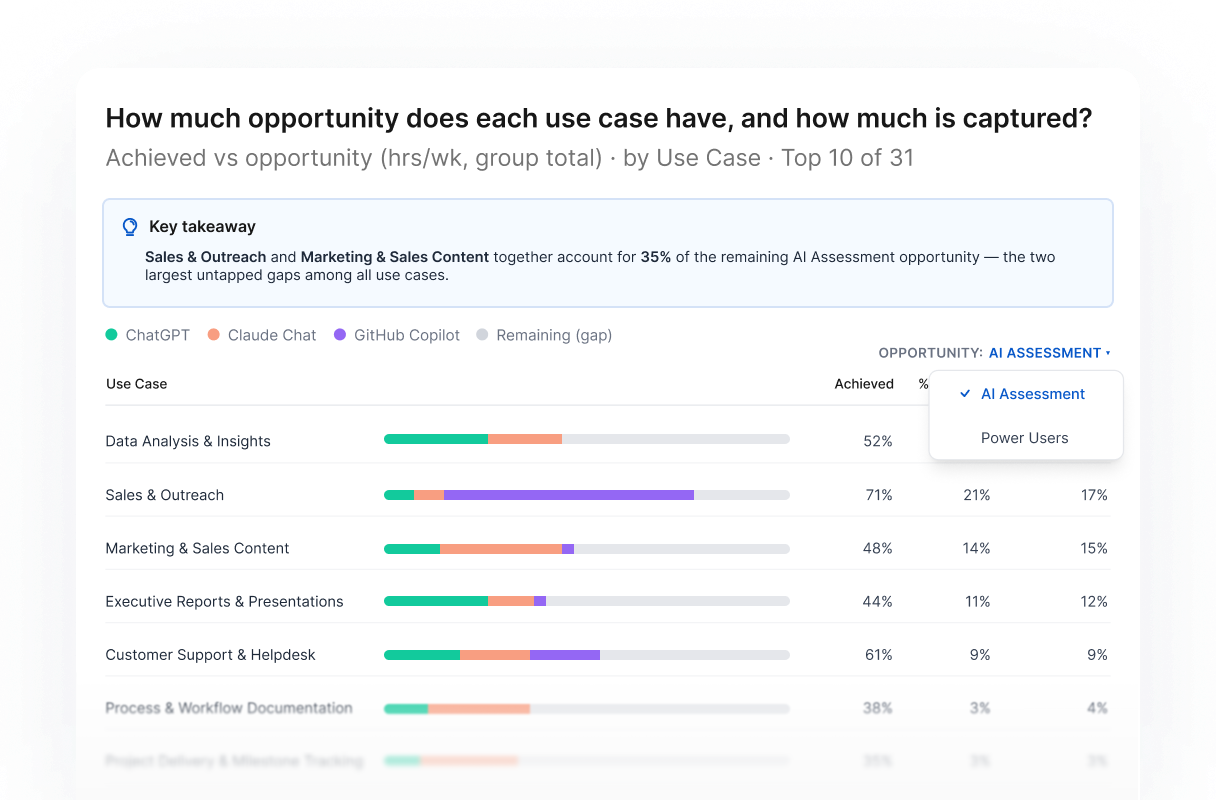
A good measurement platform helps visualize usage data alongside those outcome measures to add context to business performance and results. For example, Workhelix’s dashboards show the impact of AI usage in terms of value creation and time savings:

Where AI transformations stall
Stalled transformations often leave recognizable evidence behind. Here are the most common ones to look for:
The pilot plateau
The organization has run several successful pilots and demonstrations, but teams haven’t turned them into standard workflows.
Check: Does each promising workflow have a clear owner, a defined operating process, and sustained use outside the original pilot group?
Adoption remains concentrated
The company reports strong overall usage, but a small number of teams generate most of the activity.
Check: Break usage down by role, team, and department. Compare those figures over time to track whether adoption continues to spread.
Nobody established a baseline
Teams can point to positive examples, but nobody can quantify the change.
Check: Determine the operational metric that the initiative should affect and establish the strongest available baseline now. Historical data may provide a useful reference if the team didn’t record a pre-launch measurement.
Teams saved time without redeploying it
Employees report productivity gains, but their priorities and workloads haven’t changed.
Check: Find out where the saved capacity went. If leaders can’t identify the work that absorbed it, the organization hasn’t turned the productivity gain into a business outcome.
Approval takes longer than adoption
Employees discover useful AI applications faster than governance teams can review, approve, or integrate them.
Check: Track a sample of AI use cases through the approval process and pinpoint where they stall. Measure time-in-stage and rework at each step, then target the biggest bottleneck with a specific turnaround-time improvement.
Leadership preparedness: the variable that shapes success
Managers shape the environment in which employees adopt new ways of working. That includes AI. When managers continue to assign work, measure performance, approve decisions, and allocate capacity according to the old operating model, employees have less reason to change their own behavior.
Based on its analysis of case work involving hundreds of companies, BCG suggests there’s a 10-20-70 split when it comes to getting value out of AI: “about 10% of value from AI comes from the algorithms themselves and another 20% comes from the technology required to implement them. The remaining 70% comes from rethinking the people component.”
BCG also found that 88% of managers at companies it classified as “future-built” actively use AI in decision-making and daily operations, compared with just 25% at “AI-laggard” companies.
Together, these findings suggest that leadership preparedness is a core driver behind AI transformation. Before asking employees to change how they work, leaders should be able to articulate what they expect AI to change, who owns that change, and how they will know whether it is working.
An executive team should be able to answer four questions confidently:
- What is AI for in this business? Leaders should know the specific business outcomes they expect AI to affect. Avoid broad goals like “innovation” or “efficiency” because they leave too much room for interpretation.
- Who owns the outcome? A technology team can own an implementation, but accountability for the affected business outcome should sit with the leader who has the authority to influence and accept that outcome.
- What did we stop doing? AI should prompt teams to reconsider existing work. If they continue performing every old task while adding AI-related activities on top, they may be just creating more work instead of improving the operating model.
- How will we know it worked? Leaders need a metric, a baseline, and a timeframe. Use user feedback to understand whether the change is helping and why, and pair it with outcome data to determine whether the intended result actually occurred.
What to measure: AI transformation success metrics
When it comes to AI transformation progress monitoring, teams often measure simply what’s easy to count. But those metrics don’t show whether AI is changing the business. Here are some examples of what teams commonly measure, and the outcome-focused metrics to consider instead:
What to do if it isn’t working
Deloitte’s 2025 survey of over 1,800 executives found that most respondents reported achieving satisfactory ROI on a typical AI use case within two to four years, while only 6% reported payback within a year.
Based on these findings, keep in mind that a six-month-old initiative may need more time before leaders can assess its full financial benefits. On the other hand, a three-year-old initiative that’s produced no measurable change in usage, workflows, capacity, or outcomes deserves a closer look.
Follow these four steps if an AI initiative isn’t producing clear evidence of progress after a reasonable period of adoption:
- Establish a baseline. Identify the operational metrics most directly affected by AI and record the most credible starting point.
- Focus on high-exposure tasks. Prioritize a few tasks that have the greatest exposure to AI.
- Close the leadership gap. Before adding more technology, ensure managers can explain the intended outcome, ownership, and changed workflow.
- Re-measure at 90 days. Compare with your baseline results.
From activity to evidence
AI activity gives leaders plenty to put on a dashboard, from license numbers to new applications to adoption levels. But transformation shows up in what changes underneath those numbers, how widely people use AI, which tasks teams have redesigned, where they’ve redeployed capacity, and whether workflows now operate at scale.
If you want to measure the financial return, use the AI ROI calculator. For a broader view of adoption and task change across roles, talk to Workhelix about measuring AI-powered business transformation in your organization.
FAQs
What are the five stages of AI transformation?
Organizations use different stage models for AI transformation, and the four most commonly seen stages are: pilot, department scale, cross-function, and operating model. Ultimately, the model matters less than the evidence behind it and leaders should be able to show proof such as sustained adoption, better cross-team operation, or improved processes before claiming progress to the next stage.
How do you measure AI transformation success?
Measure weekly usage by role, tasks and workflows that have changed, capacity that teams have deliberately redeployed, workflows operating at scale, and business outcomes against a baseline. Learn more about how to measure AI ROI.
How long does an AI transformation take to show results?
Deloitte’s 2025 survey found that the top responses for time taken to realize a return on investment for typical AI use cases were: two to three years (37% of respondents); one to two years (27% of respondents); and three to four years (25% of respondents).
What’s the difference between AI transformation and digital transformation?
Digital transformation moves many business processes onto software and digital infrastructure, while AI transformation changes how people and AI systems perform the work within those processes. That includes task execution, decision-making, and workflow design. Organizations can pursue AI transformation as part of a broader digital transformation program.


